Quick Answer
Acoustic panels and acoustic lighting both help reduce sound reflections inside a room, but they are not the same product.
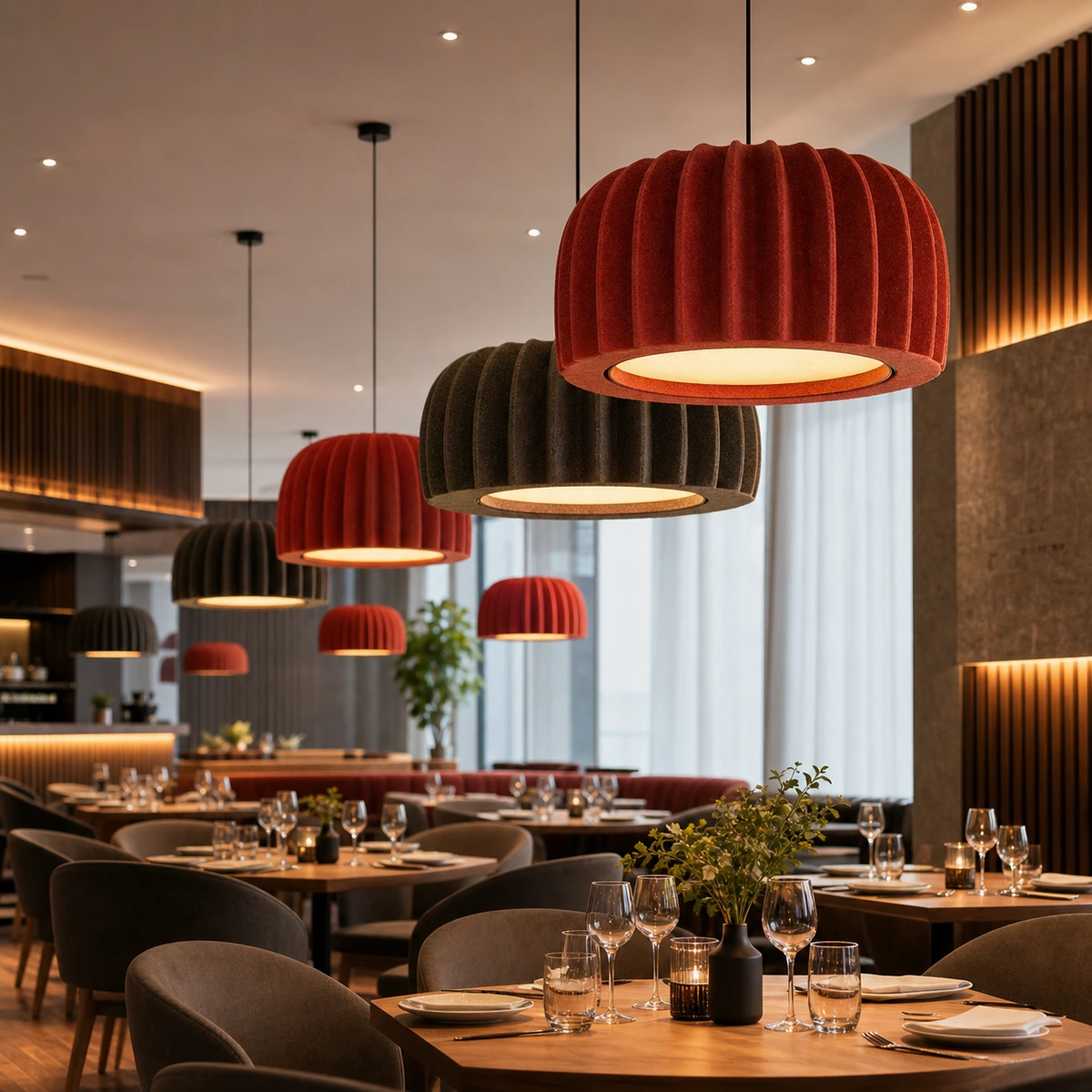
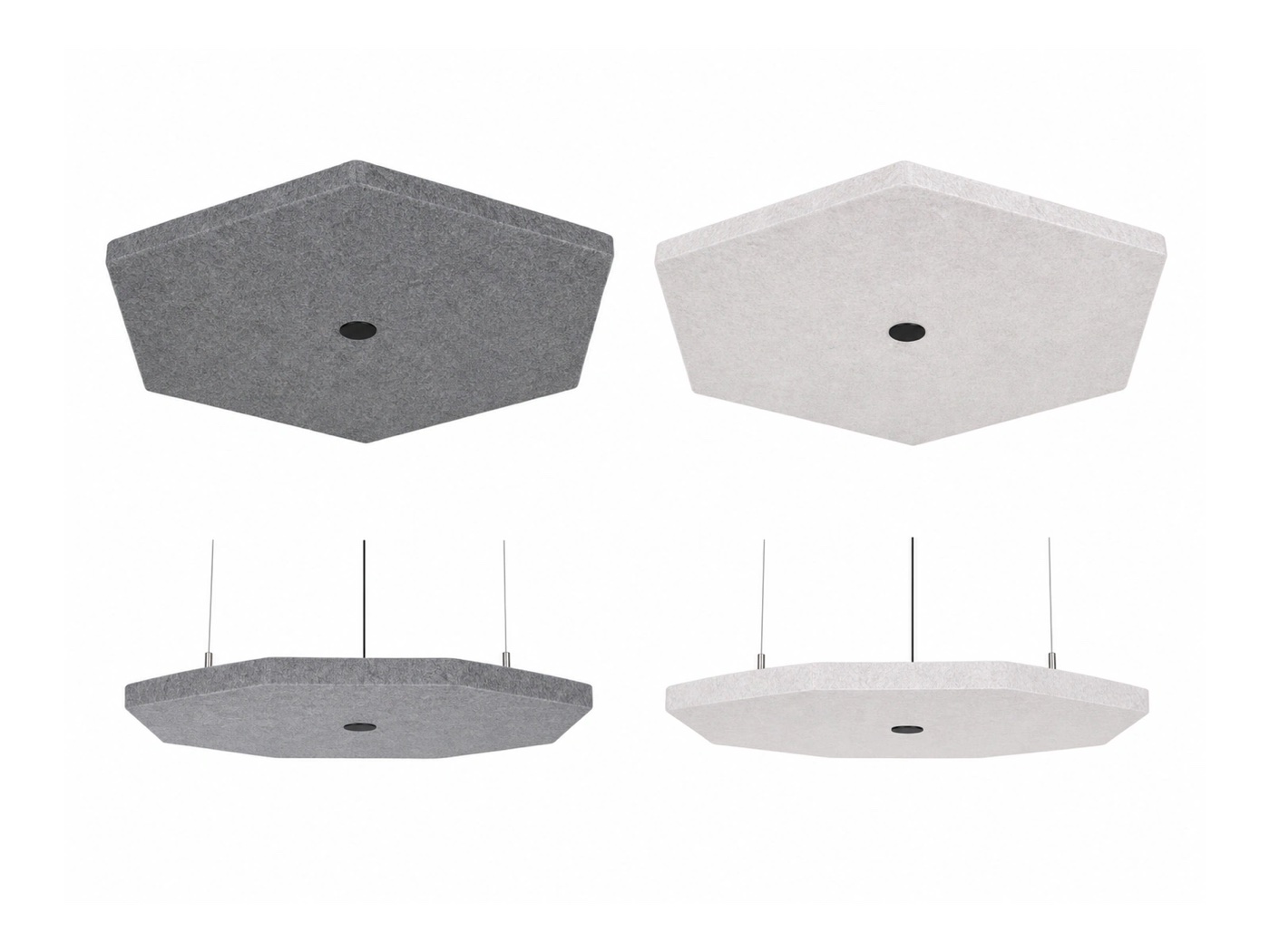
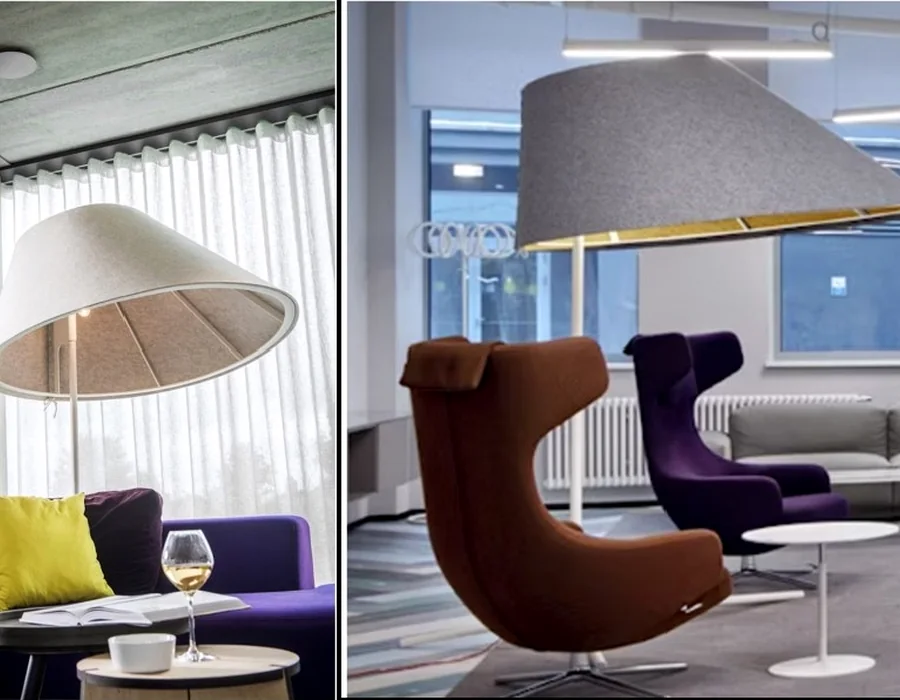
An acoustic panel is mainly a soft surface. It is installed on a wall, ceiling or suspended frame to absorb reflected sound. An acoustic light is a light fixture with acoustic material built into its body, shade, baffle or suspended form. In PET felt acoustic pendant lights, the felt body adds sound-absorbing surface while the LED system provides illumination.
Acoustic panels are like adding soft blankets to the room. Acoustic lighting is like adding a lamp that also wears part of that blanket.
If the room already has good lighting but needs more acoustic control, start with acoustic panels. If the project needs new suspended lighting and moderate acoustic comfort, acoustic lighting can solve two problems in one product. In large, hard, noisy spaces, the best answer is often both.
Why This Decision Matters
A noisy room does not usually need "more acoustic products." It needs the right surfaces in the right places.
Think of sound like a rubber ball. In a room full of glass, concrete, stone and metal, the ball keeps bouncing. That is why a modern office can look beautiful but feel tiring, or why a restaurant with great food can still feel uncomfortable because every table starts speaking louder.
Acoustic panels and acoustic lighting both give sound a softer place to land. But they do it differently:
- Acoustic panels add larger soft areas on walls, ceilings, baffles or clouds.
- Acoustic lighting adds a smaller acoustic surface inside a light fixture.
- Panels usually control more area.
- Acoustic lights also solve part of the lighting plan.
The better question is not "Which one is better?" It is: which one solves this room's problem without creating new problems for lighting, design, installation, budget, cleaning and approval?
Acoustic Panels vs Acoustic Lighting: Fast Comparison
| Decision Point | Acoustic Panels | Acoustic Lighting |
|---|---|---|
| Main role | Sound absorption | Lighting plus sound absorption |
| Best location | Walls, ceilings, baffles and clouds | Above desks, tables, counters, lounges and feature areas |
| Absorption area | Usually larger and easier to scale | Limited by fixture size and quantity |
| Lighting function | None | Built-in LED lighting |
| Design role | Can be hidden, blended or decorative | Usually visible and part of the interior concept |
| Installation | Usually no wiring | Needs suspension, wiring, driver and lighting control |
| Main checks | Material, size, thickness, NRC, fire documents and mounting | PET felt, acoustic data, lumen, CCT, CRI, glare, driver, dimming and suspension |
| Maintenance | Surface cleaning and mounting check | Surface cleaning plus electrical component access |
| Cost logic | Cost per absorbing area | Cost for two functions in one product |
| Common mistake | Expecting one small panel to fix the whole room | Expecting one decorative pendant to replace full acoustic treatment |
Plain-Language Difference
An acoustic panel is a soft surface. An acoustic light is a soft surface with a lamp built into it.
If a room is like a kitchen full of tiles, acoustic panels are like adding towels to the walls. Acoustic lighting is like replacing a hard metal lampshade with a felt lampshade that also catches some sound.
- Choose acoustic panels when the room needs more absorbing area.
- Choose acoustic lighting when the room also needs suspended light.
- Choose both when the room is large, hard, busy or acoustically important.
For a project buyer, the real comparison is not product name. It is installed area, placement, lighting performance, room function, maintenance and document readiness.
What Are Acoustic Panels?
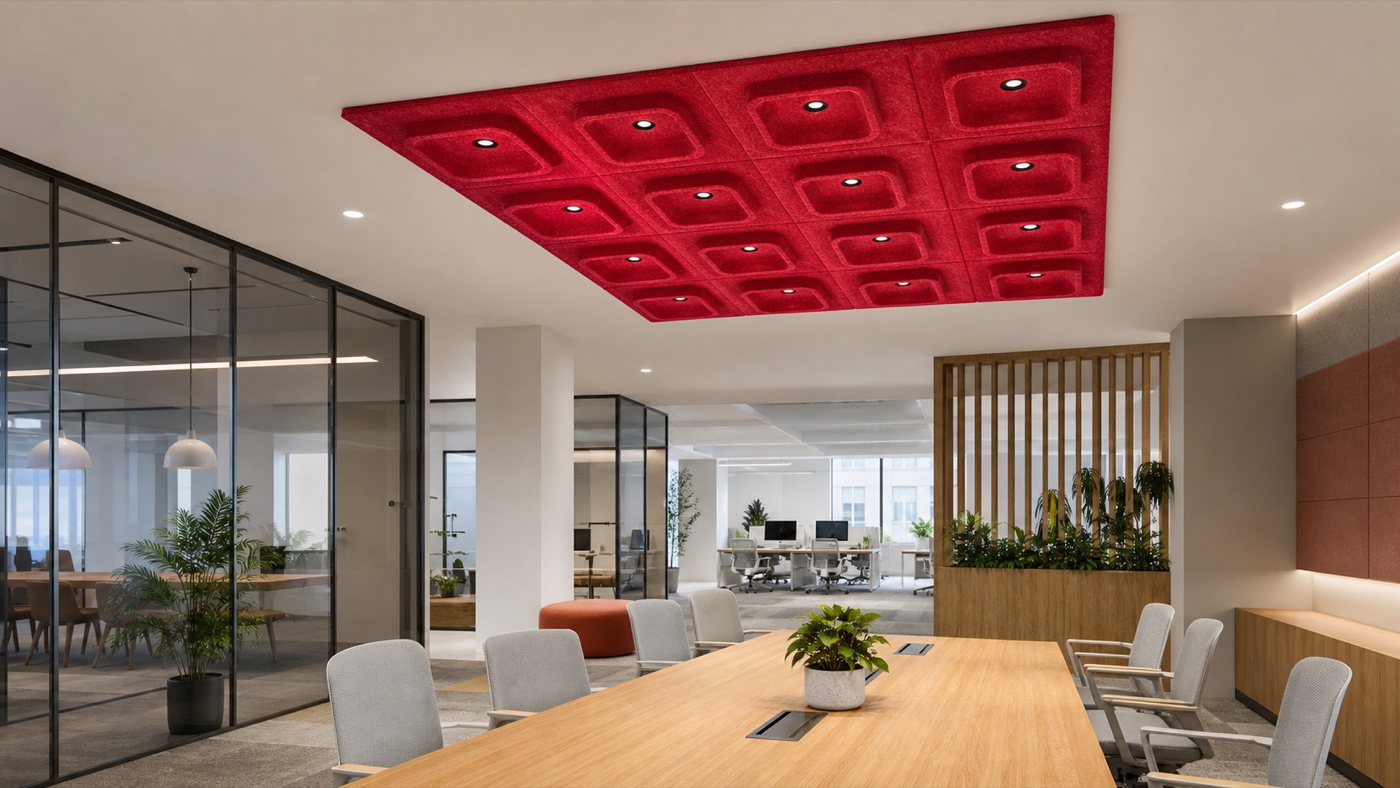
Acoustic panels are sound-absorbing products installed on walls, ceilings or suspended systems. Their main job is to reduce reflected sound inside a room. They do not light the room. They give sound waves a softer landing.
Common types include:
- wall-mounted acoustic panels;
- ceiling acoustic panels;
- hanging acoustic baffles;
- ceiling clouds;
- fabric-wrapped panels;
- PET felt panels;
- wood wool panels;
- perforated acoustic systems with backing material.
For a non-technical user, acoustic panels work like rugs, curtains or upholstered furniture. They do not stop every sound, but they make the room less hard. For a professional user, the important details include panel size, thickness, air gap, material density, mounting method, absorption coefficient, NRC, fire-related documentation, surface durability and edge finish.
What Is Acoustic Lighting?
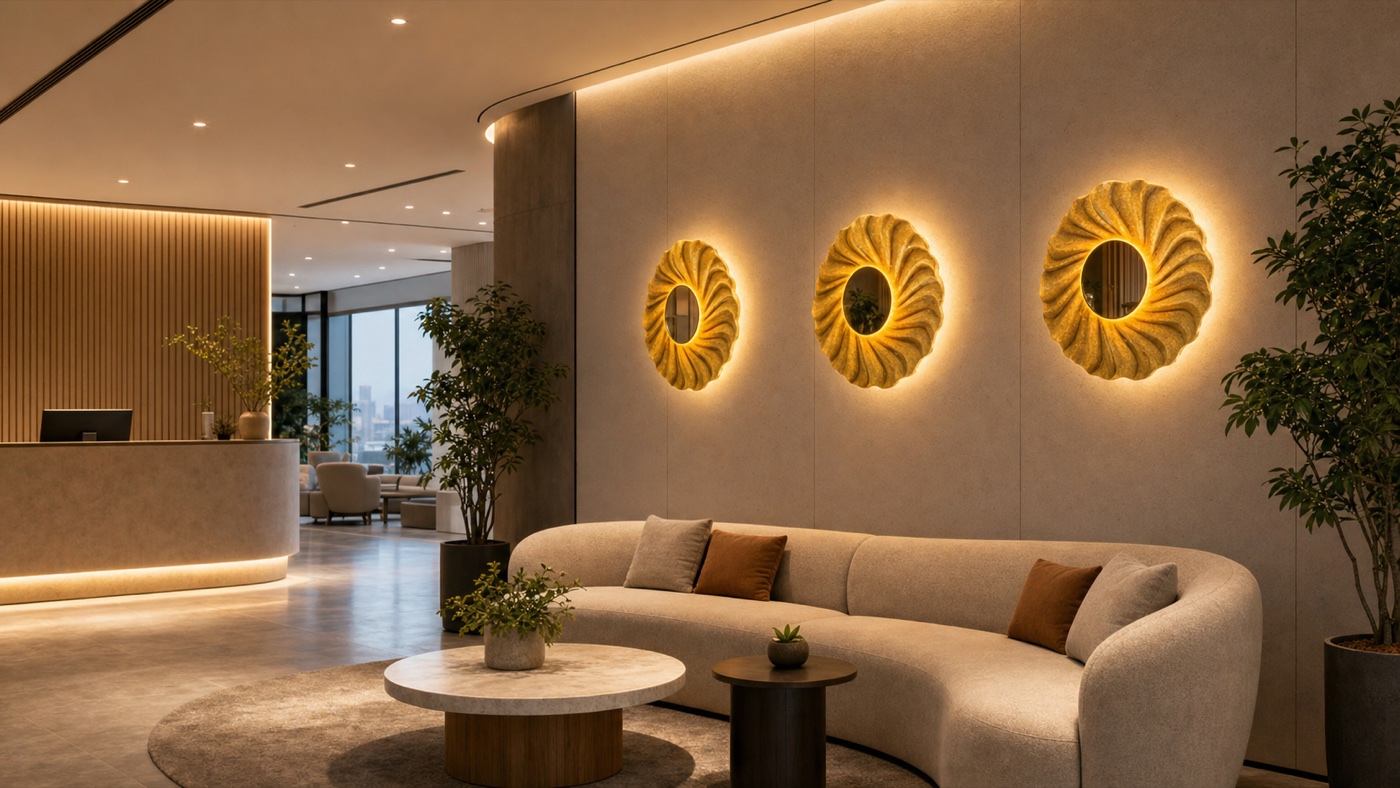
Acoustic lighting is a light fixture that includes acoustic material as part of its body, shade, baffle or suspended form. PET felt acoustic lighting is common because PET felt can be cut, shaped, colored and combined with LED modules.
A normal pendant light mainly answers: how much light does the room need, and how should the space look?
An acoustic pendant light adds another question: can this fixture add useful soft material where people sit, talk, work or eat?
Common acoustic lighting types include:
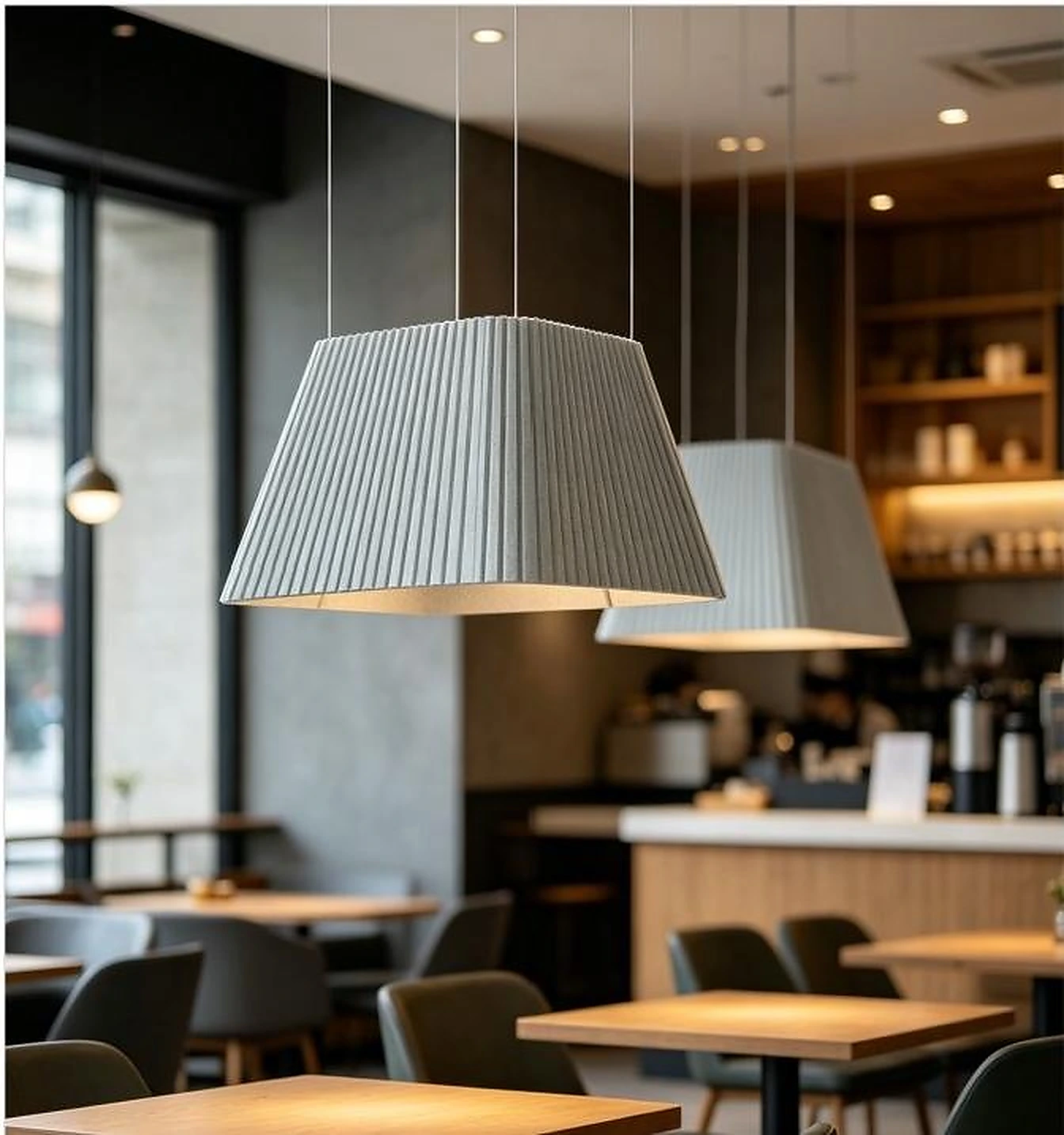
- PET felt acoustic pendant lights;
- linear acoustic pendant lights;
- round acoustic pendant lights;
- acoustic baffle lights;
- acoustic cloud lights;
- large decorative acoustic lighting features;
- custom PET felt acoustic lighting for offices, restaurants and hotels.
The main benefit is coordination. The ceiling does not always need one product for lighting and another product for absorption in the same location. The acoustic light does part of both jobs.
The limitation is also clear: one acoustic pendant usually has less absorbing area than a full wall or ceiling treatment. It can improve comfort, but it should not be sold as a complete solution for every noisy room.
Sound Absorption vs Soundproofing
This point needs to be clear before any quotation.
Acoustic panels and acoustic lighting are mainly about sound absorption. They reduce reflections inside the room. They help with echo, reverberation and harsh speech reflections.
They are not the same as soundproofing. Soundproofing means stopping sound from passing from one room to another. That usually depends on walls, doors, seals, glazing, floors and ceiling construction. A PET felt pendant or wall panel cannot fix a leaking door gap or a thin glass partition by itself.
| User Complaint | What It Usually Means | Product Direction |
|---|---|---|
| The room echoes. | Sound is bouncing inside the room. | Panels, acoustic lighting, or both. |
| The office feels noisy even when people speak normally. | Too many hard surfaces and too little absorption. | Panels plus acoustic lighting near occupied zones. |
| Guests keep raising their voices in the restaurant. | Crowd noise is building up through reflections. | Ceiling or wall absorption plus acoustic lighting over dining zones. |
| We can hear the meeting next door. | Sound is passing through a wall, door or glass. | Sound isolation review, not only panels or lighting. |
| The room looks empty and sounds sharp. | The room needs softer surfaces and better acoustic balance. | Panels, acoustic lighting, rugs, furniture and layout changes. |
ASTM C423 and ISO 354 are common reverberation-room methods for measuring sound absorption. They help move the discussion from "this feels soft" to comparable acoustic data. Real room results still depend on installed area, placement, room volume and surrounding materials.
NRC Explained Without the Jargon
You will often see NRC in acoustic product pages. NRC is useful, but it is easy to misuse.
A simple way to think about NRC is like the fuel economy number on a car. It helps compare one car with another, but it does not tell you exactly how much fuel you will use on every real trip. The result still depends on road, speed, load and driving style.
NRC works in a similar way. It helps compare how absorptive materials are under test conditions. But it does not tell you exactly how quiet a real office, restaurant or hotel lobby will become after installation.
For specification work, do not ask only: what is the NRC? Ask:
- What was tested?
- What size was tested?
- Was it a flat panel, hanging object or finished fixture?
- How much absorbing area will we actually install?
- Where will it be installed in the room?
- Does the test condition match the planned use?
That is the difference between buying a number and specifying a solution.
When Acoustic Panels Are the Better Choice
Specify acoustic panels first when the room needs a lot of sound absorption and lighting is already solved.
This often happens in:
- open offices with wide ceiling areas;
- meeting rooms with hard parallel walls;
- classrooms or libraries with speech clarity requirements;
- hotel corridors with long reflective surfaces;
- restaurants with high ceilings and exposed structures;
- multipurpose rooms where noise changes by event type.
Panels also make sense when the buyer needs more predictable coverage. If an acoustic consultant is calculating absorption area, wall and ceiling panels are easier to count. They are like adding square meters of "soft landing" to the room.
However, panels do not solve lighting. If the space also needs new pendant lights, panels alone may leave the project with two separate systems: lighting plus acoustic treatment. That can still be the right answer, but it should be planned early.
When Acoustic Lighting Is the Better Choice
Specify acoustic lighting when the project already needs suspended lighting and the room also needs acoustic comfort.
This is common in:
- open offices and meeting rooms;
- restaurants and cafes;
- hotel lobbies and lounges;
- reception counters;
- coworking spaces;
- retail consultation areas;
- library reading tables;
- school collaboration zones.
Acoustic lighting is especially useful when the ceiling is busy. Many projects already have HVAC, sprinklers, sensors, speakers, cameras and cable trays. Adding separate lights and separate acoustic panels can make the ceiling look crowded. Acoustic lighting combines two layers.
It also helps when the client does not want the "panel look." In hospitality interiors, panels can feel too technical if they are not designed carefully. A PET felt acoustic pendant can look like a deliberate design feature while still adding absorption.
But the buyer must still treat it as a light. Ask for lumen output, CCT, CRI, glare information, dimming protocol, driver details, installation method and photometric files.
Offices: Which Should You Specify?
Office acoustic problems are rarely about one loud person. They are usually about too many conversations bouncing around the same hard space.
An open office without acoustic treatment is like a group chat where everyone sends voice messages at the same time. Nothing is private, and everything competes for attention.
Open Workstation Areas
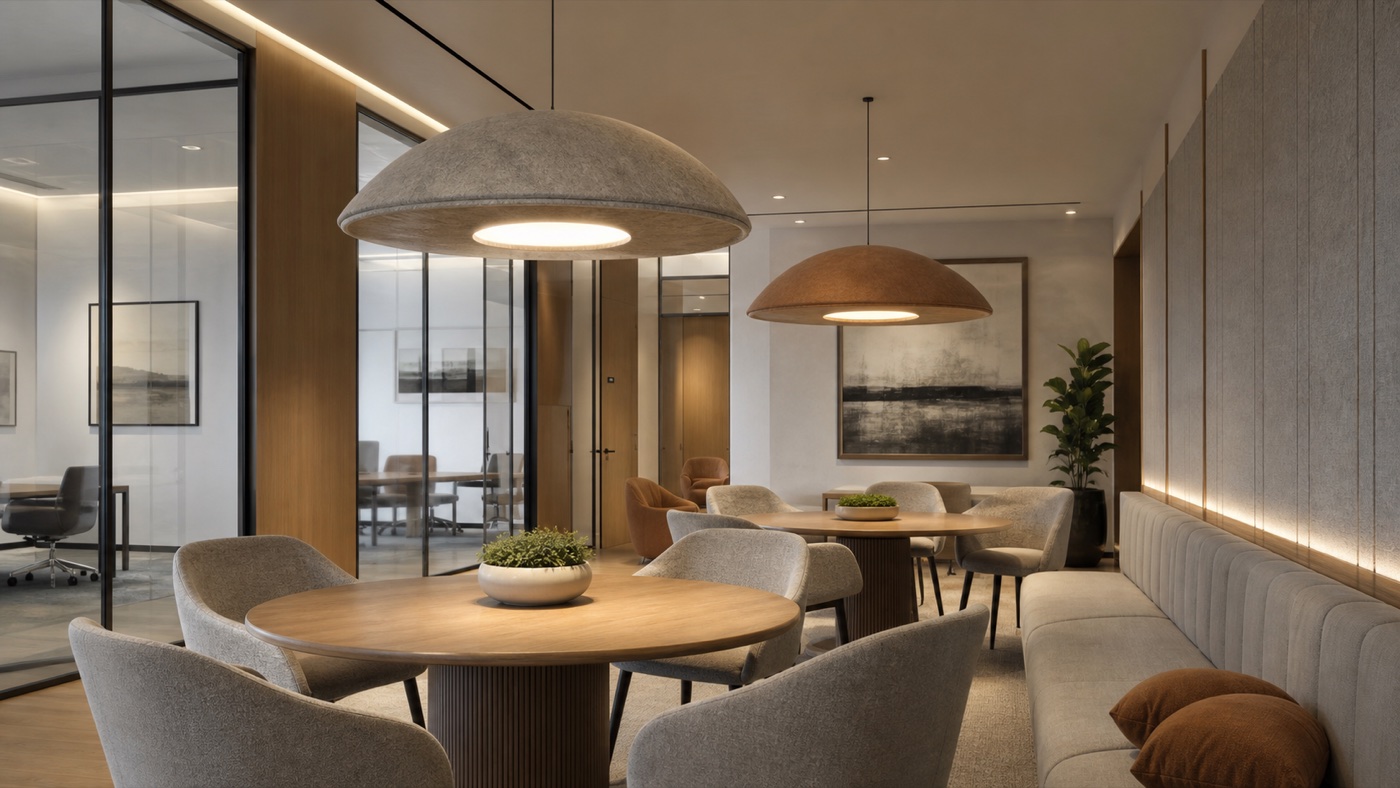
For open workstations, use acoustic panels when the whole floor needs broad control. Ceiling panels, baffles or wall panels can reduce the overall reflected sound in the space.
Use acoustic lighting when the project also needs lighting above desk rows or collaboration tables. Linear PET felt acoustic pendant lights can follow workstation rows and add absorption near the occupied zone.
A practical specification is often:
- acoustic ceiling or wall treatment for general control;
- linear acoustic pendant lighting above key desk or meeting zones;
- soft furniture, carpet or workstation screens where needed;
- proper glare control and CCT for visual comfort.
If the office already has enough light, panels may be the cleaner acoustic answer. If the lighting plan is still open, acoustic lighting can save coordination time. For more detail, see the guide to acoustic pendant lighting for open offices and meeting rooms.
Meeting Rooms
Meeting rooms are different. A small room with glass walls and a hard table can sound sharp even with only four people inside.
Acoustic panels are often helpful on side walls or the back wall because they reduce flutter echo and speech reflections. Acoustic lighting is useful above the table because it combines table lighting with absorption close to the conversation area.
A good meeting room often needs both: wall panels to calm the room and an acoustic pendant to soften the table zone.
Boardrooms and Executive Rooms
In boardrooms, appearance matters more. Acoustic lighting can become the centerpiece, especially with custom PET felt shapes or colors. Still, do not rely on the pendant alone if the room has too much glass, stone or wood. The acoustic light can be the visible hero. Panels can do the quieter background work.
Restaurants: Which Should You Specify?
Restaurants have one tricky problem: the room must feel alive, but not exhausting. A restaurant that is too quiet can feel empty. A restaurant that is too loud makes guests leave tired. The goal is not silence. The goal is comfortable energy.
Acoustic panels are useful when the restaurant has:
- high ceilings;
- exposed concrete;
- glass facades;
- hard floors;
- long walls;
- large dining rooms;
- private rooms with echo.
Panels can be installed as ceiling rafts, wall features, hidden treatments or decorative surfaces. They provide more absorption area and are often better for controlling the whole dining room.
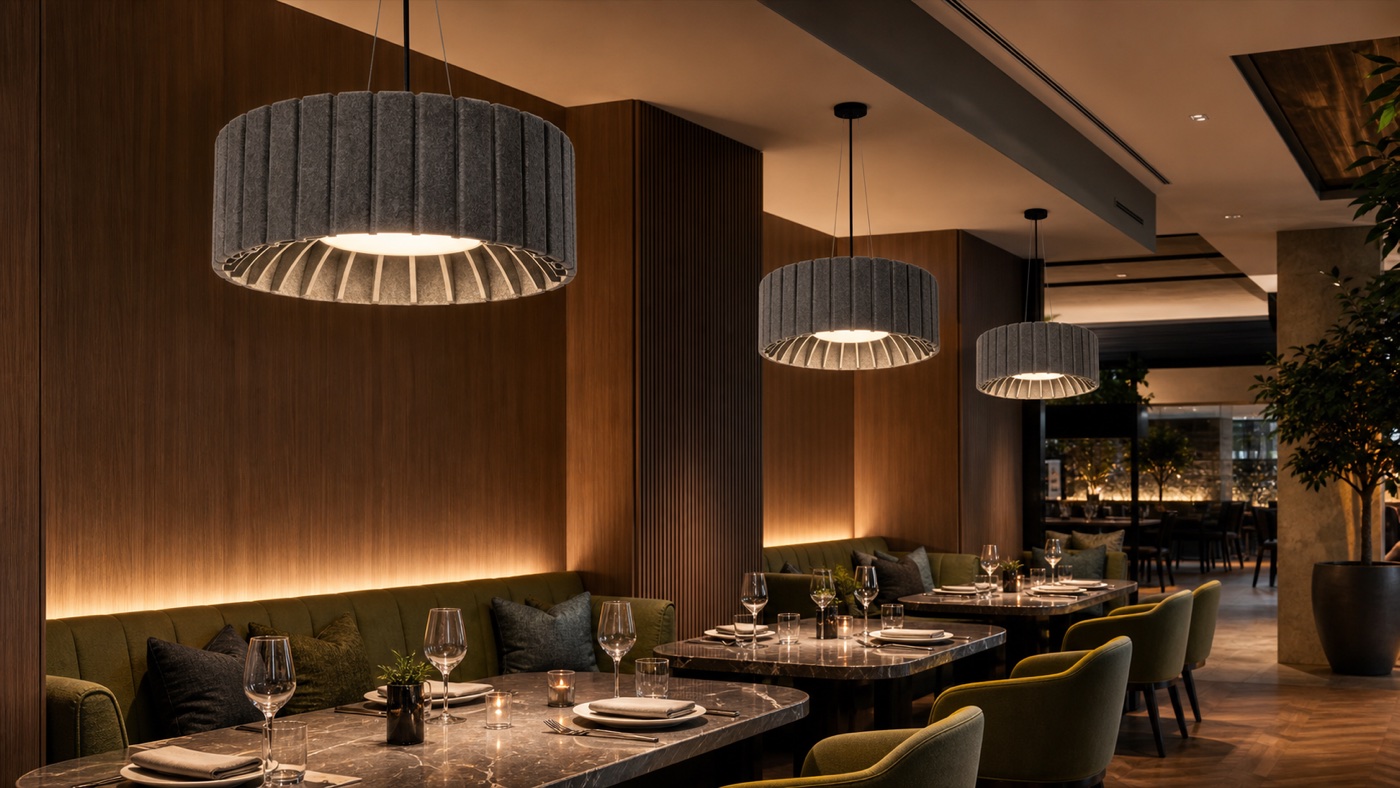
Acoustic lighting is useful when the dining area also needs atmosphere. Warm PET felt pendants above tables can soften reflections while supporting the brand mood. This is why acoustic lighting is attractive for restaurants and hospitality interiors.
For restaurants, the decision is not only acoustic. Cleaning matters. Dust, oil, smoke exposure, food-service conditions and maintenance height all matter.
A practical restaurant route:
- use acoustic lighting above dining tables or feature zones;
- use panels or baffles on ceilings and walls for larger absorption area;
- choose warm CCT and dimming carefully;
- confirm material cleaning guidance;
- ask early for fire-related documents if required by the project.
Hotels: Which Should You Specify?
Hotels are not one acoustic condition. A lobby, restaurant, corridor, guest room, conference room and ballroom all behave differently.
Hotel Lobbies
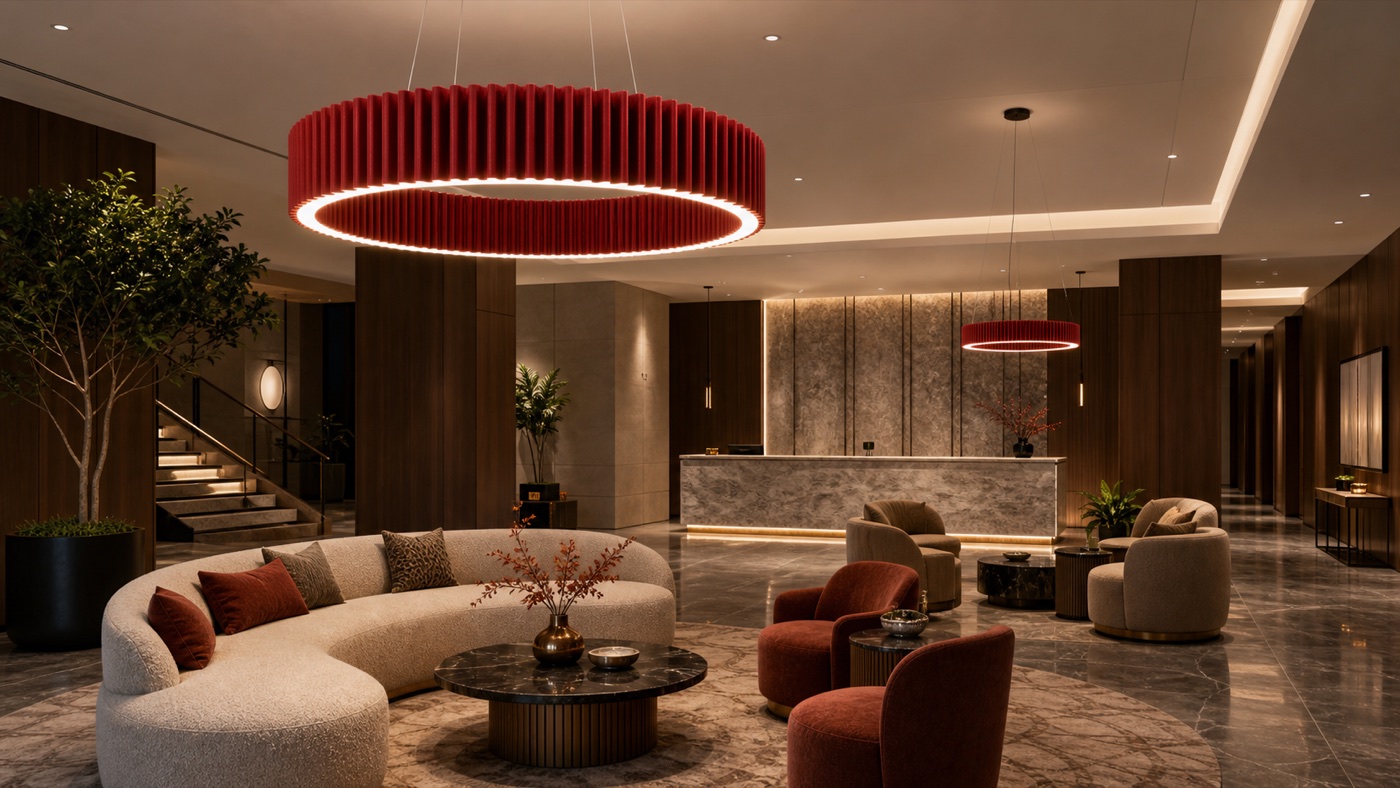
Hotel lobbies often have tall ceilings, stone floors, glass walls and large open volume. One acoustic pendant cannot control the whole space, but large PET felt acoustic lighting can help break up reflections and create a visual anchor.
In lobbies, acoustic lighting is often chosen for design first and acoustic support second. That is acceptable when the project team understands the limit. For stronger control, combine large acoustic lighting features with panels, baffles or hidden acoustic treatments.
Hotel Restaurants and Lounges
In hospitality dining areas, acoustic lighting is often a good fit. It supports ambience, improves comfort and does not look like a technical retrofit. Use acoustic panels when the space still has too much reverberation after lighting placement, or when large ceiling and wall areas are available for treatment.
Hotel Meeting and Conference Rooms
Treat these more like office meeting rooms. Panels usually provide the main acoustic control, while acoustic lighting can support the table zone and interior design.
Ballrooms and Event Spaces
Do not rely on product-level guesses. These rooms change by event type: speeches, music, banquets, conferences and weddings. They usually need professional acoustic planning. Acoustic lighting can be part of the design, but panels, movable partitions, curtains and ceiling treatments may still be needed.
A Better Decision Framework: Surface, Light and Story
1. Where Is the Missing Soft Surface?
If the room has large hard walls and ceilings, panels may be the fastest way to add enough absorption. If the main activity happens under tables, desks or lounge areas, acoustic pendants can place absorption closer to people.
2. Does the Room Also Need Lighting?
If the lighting is already installed and approved, panels may be simpler. If the project needs new pendant lights anyway, acoustic lighting can combine two needs.
3. What Should the Product Say Visually?
Panels can disappear or become a wall feature. Acoustic lighting usually becomes part of the interior story. In a hotel or restaurant, that story may be valuable. In a back-office meeting room, a simple wall panel may be better.
Cost: Do Not Compare Unit Price Only
A unit price comparison can be misleading. An acoustic panel may cost less than an acoustic pendant light. But the pendant also includes a lighting system, driver, suspension, canopy, diffuser and electrical assembly.
At the same time, one acoustic pendant does not equal a wall full of panels. If the room needs serious absorption, panels may be more cost-effective per acoustic area.
What does this product replace, and what does it still leave unsolved?
| Cost Item | Acoustic Panels | Acoustic Lighting |
|---|---|---|
| Product cost | Usually lower per square meter of absorption | Higher because it includes lighting and electrical parts |
| Installation | Often simpler | Requires electrical and suspension work |
| Design value | Can be low or high depending on finish | Often high because it is a visible feature |
| Acoustic coverage | Easier to scale | Limited by fixture quantity and size |
| Lighting replacement | No | Yes, if it replaces decorative or task pendant lights |
| Documentation needs | Acoustic, fire, material and mounting | Acoustic, fire, material, photometric, driver, electrical and installation |
If the project only needs absorption, panels may win. If the project needs both lighting and acoustic comfort, acoustic lighting may reduce the number of separate products.
Installation and Maintenance
Panels are usually easier to install because they do not need wiring. The main questions are mounting method, wall or ceiling condition, weight, fire documents and surface durability.
Acoustic lighting needs more coordination. It is a luminaire, so the buyer must confirm:
- suspension points;
- canopy type;
- driver location;
- wiring method;
- input voltage;
- dimming protocol;
- installation height;
- fixture weight;
- accessory kits;
- room-by-room labeling for large projects.
Maintenance also differs. Panels need surface cleaning and occasional inspection. Acoustic pendant lights need surface cleaning plus future access to lighting components. A driver failure in an easy-to-reach pendant is one thing. A driver failure high above a hotel lobby is another.
For restaurants, ask about cleaning before you fall in love with the shape. A product that looks perfect in a render still needs to live in a real space with dust, air movement and maintenance staff.
Document Set: What Buyers Should Request
This is where many projects become slow. The product is selected and the price is approved, but the project team later asks for documents that were never discussed. Do not wait until after the purchase order.
Acoustic Panel Document Set
- Product datasheet.
- Material description.
- Acoustic test report or absorption data if required.
- Fire-related document if required by the project.
- Mounting instructions.
- Color card or finish sample.
- Cleaning and maintenance guide.
- Packing method.
- Warranty terms.
Acoustic Lighting Document Set
- Product datasheet with dimensions, weight, material, wattage, CCT, CRI, voltage and dimming.
- PET felt material sheet.
- Acoustic report or sound absorption data if required.
- Fire-related material document if required.
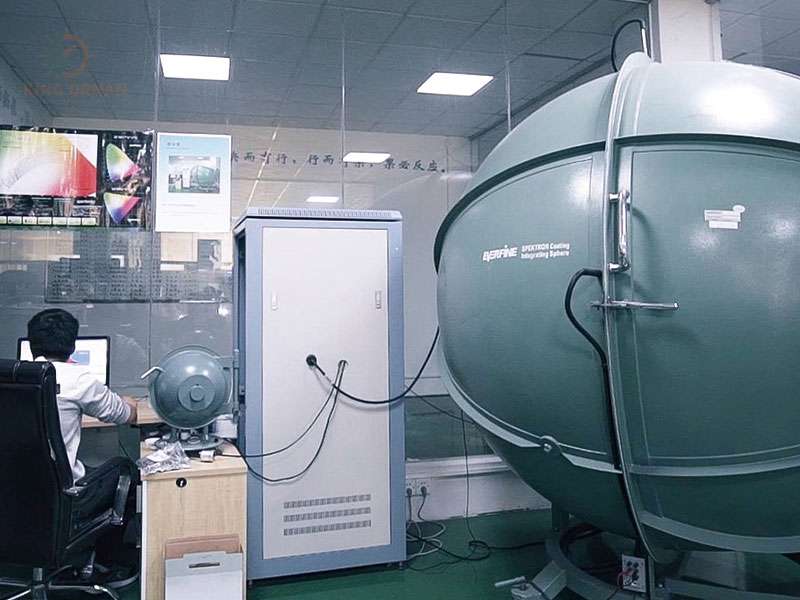
- IES or LDT photometric file if lighting review is required.
- LED driver datasheet.
- Dimming compatibility information: TRIAC, 0-10V, DALI or other.
- Installation manual.
- Suspension kit details.
- Canopy information.
- Color card or physical sample.
- Packing and carton details.
- Bulk QC checklist.
- Warranty terms.
If a supplier cannot provide every document immediately, that is not always a problem. But the supplier should be honest about what is available, what can be prepared and what depends on the destination market or project requirement.
RFQ Checklist: What to Send Before Asking for a Quote
A poor RFQ says:
Please quote acoustic panels and acoustic lights. Best price.
A better RFQ says:
We are designing a 450 m2 office with open workstations, three meeting rooms and a reception area. The space has exposed concrete ceiling, glass partitions and hard flooring. We need acoustic comfort and new pendant lighting above desk rows and meeting tables. Please suggest acoustic lighting and panel options with PET felt colors, acoustic data, IES/LDT files, dimming options, installation method and estimated lead time.
Before asking for a quote, prepare:
- project type: office, restaurant, hotel, school, retail or mixed-use;
- room size and ceiling height;
- drawings, photos or renderings;
- main complaint: echo, speech distraction, dining noise, meeting clarity or general comfort;
- existing lighting plan or new lighting requirement;
- preferred product types: wall panels, ceiling panels, pendant lights, baffles or custom features;
- target quantity or area;
- PET felt color or finish preference;
- CCT, CRI, wattage and dimming needs if lighting is included;
- destination country;
- fire-related or electrical document needs;
- delivery schedule;
- installation constraints.
A clear RFQ does not just help the supplier. It helps the buyer compare quotations fairly.
Not sure whether your project needs panels, acoustic lighting, or both?
Send room type, ceiling height, drawings, photos, lighting requirements and acoustic concerns. We can recommend a practical acoustic lighting direction for RFQ.
Common Specification Mistakes
Asking only which product has better NRC
A small product with good material data may still provide little total absorption. Ask about total installed area, placement and room conditions.
Using acoustic lighting as a full panel replacement
Acoustic lighting can reduce the need for some separate acoustic products, but large, hard rooms often still need panels or baffles.
Choosing panels without checking design impact
Panels are not always invisible. In hotels and restaurants, acoustic products should feel like part of the interior design.
Choosing acoustic pendants without lighting data
A PET felt pendant still needs to light the space. Ask for light output, CCT, CRI, driver, dimming and photometric files.
Forgetting cleaning and access
Restaurants, hotels and high-ceiling spaces need practical maintenance planning before production.
Approving color by screen
PET felt color can look different on a monitor. Use a physical sample or color card for large projects.
Treating every space the same
An open office, restaurant and hotel lobby do not need the same solution. Start with the room, not the product.
Example Specification Routes
Open office
Use acoustic panels or ceiling baffles for broad absorption. Add linear PET felt acoustic pendant lights above workstation rows where new lighting is needed. Use meeting room wall panels and a larger acoustic pendant above each meeting table.
Restaurant
Use decorative PET felt acoustic pendants above dining tables to support ambience. Add ceiling or wall acoustic panels where the room needs more absorption. Choose warm CCT, dimming, cleanable finishes and fire-related documents if required.
Hotel lobby
Use large custom acoustic lighting as a visual feature. Add hidden or decorative acoustic panels to upper walls, ceiling zones or seating areas. Do not expect one chandelier-style acoustic fixture to control the entire lobby volume.
Meeting room
Use a PET felt acoustic pendant above the table for light and local absorption. Add wall panels where speech reflection is strongest. Confirm dimming, glare, video-call comfort and installation height.
FAQ
Are acoustic panels better than acoustic lighting?
Not always. Acoustic panels are usually better for adding large areas of absorption. Acoustic lighting is better when the space also needs pendant lighting and a visible design feature. In many offices, restaurants and hotels, the best answer is both.
Can acoustic lighting replace acoustic panels?
Sometimes it can reduce the need for separate panels, especially in smaller or moderate spaces. In larger, harder or noisier rooms, acoustic lighting should be part of a broader acoustic plan.
Are acoustic panels cheaper than acoustic pendant lights?
Panels are usually cheaper per square meter of absorption. Acoustic pendant lights cost more because they include lighting components, suspension, driver and electrical assembly. But they may replace a separate decorative pendant light.
Do acoustic panels or acoustic lights soundproof a room?
No. They mainly absorb reflections inside a room. Soundproofing requires construction measures to block sound traveling between spaces.
What is better for open offices?
Open offices often need panels or baffles for broad control, plus acoustic lighting above desk rows, meeting tables and collaboration zones if new lighting is required.
What is better for restaurants?
Restaurants often benefit from a mix. Acoustic lighting supports ambience above dining areas. Panels or baffles provide more absorption across ceilings and walls.
What is better for hotels?
It depends on the space. Hotel lobbies often need both custom acoustic lighting and larger acoustic treatments. Meeting rooms need wall absorption plus good table lighting. Restaurants and lounges can use acoustic pendants as part of the design.
Should I compare products by NRC only?
No. NRC helps compare material absorption, but the room result depends on product size, installed area, placement, room volume and other finishes.
What documents should I ask for?
For panels, ask for material, acoustic data, fire-related documents, mounting instructions and cleaning guidance. For acoustic lighting, also ask for IES or LDT files, LED driver data, dimming information, installation manual and electrical documents if required.
Can PET felt acoustic lighting be customized?
Yes. PET felt acoustic lighting can often be customized by shape, size, color, LED wattage, CCT, CRI, dimming protocol, suspension length, canopy finish, packaging and private-label requirements.
Related Reading and Product Pages
- What Is Acoustic Pendant Lighting? PET Felt Lights Explained
- How to Choose PET Felt Acoustic Pendant Lights
- Best Acoustic Pendant Lighting for Open Offices and Meeting Rooms
- How to Compare PET Felt Acoustic Lighting Manufacturers
- Acoustic Pendant Lights
- Acoustic Linear Lights
- Acoustic Ceiling and Wall Lighting
- Custom Acoustic Lighting Solutions
Request Project Review
Planning an office, restaurant or hotel project?
Send room type, ceiling height, drawings, photos, lighting requirements and acoustic concerns. We can help review whether acoustic panels, PET felt acoustic pendant lights, or a combined route makes the most sense.